

Ukraine Peace Negotiations Advance With Revised Plan
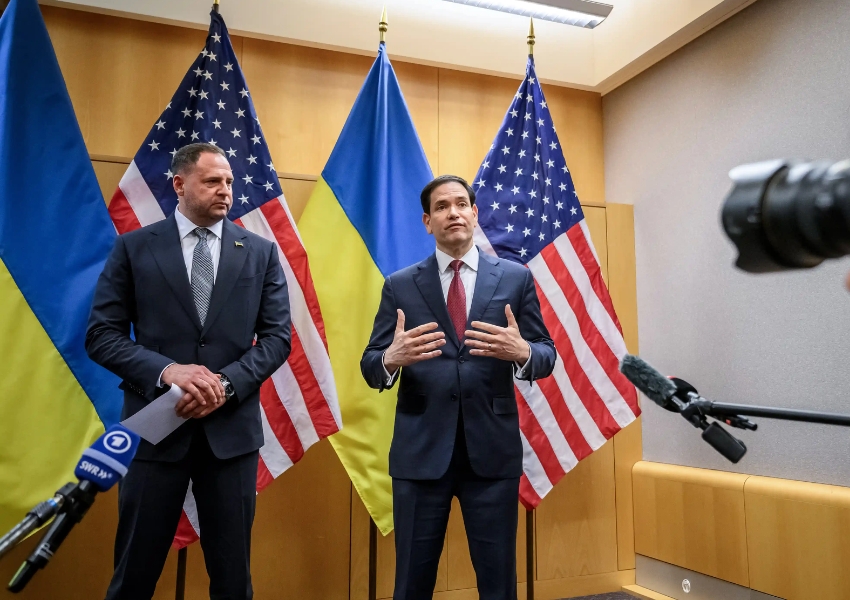

Ukraine Peace Negotiations
Image Credit: The New York Times
Pressure around a potential peace deal in Ukraine intensified this week as diplomatic discussions accelerated in Geneva. While Donald Trump continues to push for an agreement before Thanksgiving, Ukrainian officials have held firm that any settlement must protect core national interests and avoid terms that resemble capitulation. The latest round of talks, however, appears to have shifted the conversation, producing what U.S. and Ukrainian negotiators describe as an updated peace framework that could eventually serve as the basis for further negotiation.
U.S. officials, joined by national security advisers from Germany, France, and the UK, met Ukrainian delegates throughout Sunday in a series of tightly controlled sessions. Kyiv’s negotiation team arrived under clear pressure, as the United States initially presented a draft strongly aligned with Russia’s demands. That proposal drew immediate resistance, prompting the Ukrainian side to seek adjustments before moving forward. The urgency surrounding the process was evident in the rapid back‑and‑forth between meeting venues, with both delegations arriving in consecutive motorcades.
According to attendees, the starting draft was so favorable to Moscow that U.S. Secretary of State Marco Rubio was compelled to deny claims that the Kremlin had authored the document. Nevertheless, Washington maintained its push for significant progress, and Trump reiterated that Ukraine faced consequences if it failed to take the negotiations seriously. This backdrop raised tensions early in the talks, but by Sunday evening U.S. officials were signaling a more optimistic tone.
Rubio announced that “tremendous progress” had been made, noting that only a few unresolved issues remained. While he avoided describing specific provisions, he referenced the delicacy of the process and emphasized the need for continued discretion. Hours later, a joint statement from Washington and Kyiv confirmed the emergence of a “revised framework document,” signaling a major departure from the original proposal.
Although the updated peace plan has not been released publicly, Ukrainian Deputy Foreign Minister Sergiy Kyslytsya described it as a 19‑point document retaining very little from the earlier draft. Reporting from Reuters and other outlets suggests that several European amendments shaped the new version, including the removal of an automatic veto on Ukraine’s future NATO membership. Proposed limits on the size of Ukraine’s armed forces were also withdrawn.
Territorial issues remain highly sensitive, but the revised approach does not require Ukraine to surrender the remaining parts of the Donbas region. Instead, it reaffirms that Kyiv would pursue the return of occupied territory through diplomatic channels—a position Ukraine’s leadership has previously endorsed. The controversial provision granting full amnesty for war crimes was also removed.
Another significant point of the negotiations involves security guarantees. Several leaders, including UK Prime Minister Keir Starmer, have referenced the possibility of long‑term commitments resembling NATO’s Article 5, which would obligate the United States to come to Ukraine’s defense if Russia launched another attack. Ukrainian officials have consistently stated that meaningful security assurances are non‑negotiable and essential for any lasting agreement.
Germany’s Chancellor Friedrich Merz called the evolving framework “significantly modified” in a positive direction, though he, too, avoided commenting on specifics. The rapid shift in tone—from a draft seen as overtly favorable to Russian interests to a more balanced document—has surprised many observers. Some analysts attribute the change to strong European pushback, while others point to strategic recalculations within the U.S. delegation.
The original proposal was reportedly influenced by Steve Witkoff, Trump’s envoy, who had visited Russian President Vladimir Putin earlier this year. His meeting was followed by remarks echoing several of Russia’s stated positions, raising questions about the foundation of the first draft. The current framework, however, appears to reflect a broader range of viewpoints and includes elements Ukraine may consider acceptable under specific circumstances.
Trump has since adopted a more upbeat tone, saying that “something good” could emerge from the talks. Yet the fundamental challenge remains: there is still no indication that Moscow is prepared to halt its military campaign unless compelled. Analysts note that Russia’s confidence has grown due to recent battlefield gains, recruitment difficulties in Ukraine, and ongoing political disputes in Kyiv.
Despite these constraints, some believe the diplomatic surge may still prove valuable in encouraging long‑term dialogue. For Ukraine, the appeal of a credible peace plan is obvious; after nearly eleven years of conflict, securing an end to the fighting remains the ultimate priority. But officials stress that peace must not come at the cost of sovereignty or basic security.
As discussions continue, both supporters and critics acknowledge that Sunday’s developments represent a small but notable shift. The updated framework may not be a final deal, but it signals potential pathways that were not available days earlier. Whether the plan gains traction will depend on future talks, Russia’s willingness to negotiate, and the capacity of Ukraine’s allies to maintain united pressure.
For now, the revised draft stands as a reminder of the complex diplomatic landscape that surrounds the conflict. It offers Ukraine a document that could, in time, become the basis for a negotiated peace—but only when the conditions align and the parties involved are ready to move beyond the battlefield toward long‑term stability.
This content was adapted from an article in BBC