

UK Tests AI Plane Contrails Avoidance Over Atlantic
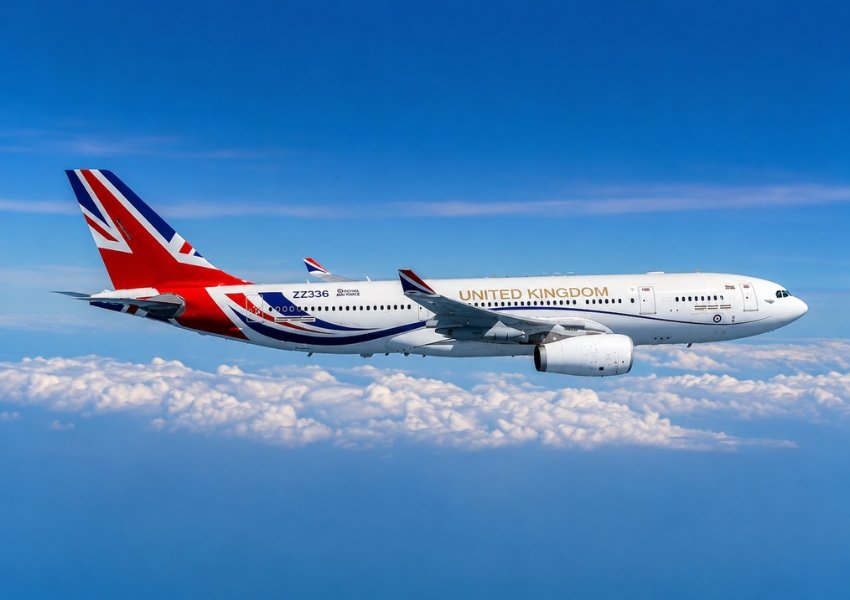

Image Name: AI plane contrails
The UK government, Google and aviation partners will test whether AI plane contrail forecasting can help flights avoid climate-warming vapor trails over the North Atlantic in a 30-month Operation Blue Skies trial focused on Shanwick airspace. The project will use AI weather forecasting, satellite imagery and flight data to predict where persistent airplane contrails are likely to form, then guide selected aircraft around those zones.
The £5 million program brings together the UK Department for Transport, Google, the Met Office, National Air Traffic Services, Contrails.org, Imperial College London and the University of Cambridge, according to AP. The government is funding more than half of the study, which will run test periods during this winter and next.
Contrails, sometimes called “sky graffiti,” form when hot aircraft exhaust meets very cold, humid air at high altitude. Many vanish quickly. Others persist, spread into thin cloud layers, and trap heat that would otherwise escape from Earth.
AI Plane Contrails Trial Over Shanwick
The trial will focus on Shanwick Oceanic airspace, the eastern half of the North Atlantic corridor managed by UK and Irish air navigation services. Modeling cited by AP says Shanwick accounts for about 5% of global contrail warming, with a significant share occurring during winter.
The system will combine Google AI aviation trial methods with weather patterns and past flight data to identify areas where contrail-forming conditions are likely. Air traffic controllers at NATS can then direct pilots to avoid those atmospheric layers. The changes are expected to be small.
Rather than major flight rerouting, the trial will mostly involve aircraft climbing or descending by up to 2,000 feet, or about 610 meters. AP reported that this type of altitude change already occurs in normal operations to avoid turbulence and bad weather. Testing will take place during selected evenings and nights in the winters of 2026-27 and 2027-28, when air traffic is lower. Around 10,000 flights are expected to pass through the trial area, though only a fraction are likely to need altitude changes specifically for contrail avoidance.
Why Contrails Matter for Aviation Climate Impact
Aviation emissions are usually discussed through carbon dioxide, but non-CO₂ effects also matter. Contrails are one of the biggest uncertainties in aviation climate impact because their warming effect depends on time of day, altitude, humidity, temperature and cloud conditions. Google’s contrail research project says the 2022 IPCC report noted that clouds formed by contrails account for roughly 35% of aviation’s global warming impact, more than half the effect of the world’s jet fuel.
That is why AI climate technology is drawing attention in green aviation. If forecasts can accurately identify only the flights most likely to create warming contrails, airlines may be able to reduce climate impact without changing most routes. The approach targets a narrow atmospheric problem instead of asking every flight to take a longer path.
Google said earlier research with American Airlines showed AI-based forecasts could reduce contrails on test flights. In a 2026 study involving 2,400 transatlantic flights, Google said successful avoidance plans produced a 62% reduction in contrail formation rate compared with a control group. An earlier AP report on the same American Airlines and Google work said researchers estimated the trial reduced climatological warming from affected flights by about 69%.
Fuel Penalty Remains Key Question
The main scientific and operational question is whether avoiding contrails creates a net climate benefit. Changing altitude can burn more fuel, which increases carbon emissions.
That trade-off sits at the center of sustainable flight research. Supporters of contrail avoidance argue that the additional fuel cost can be small compared with the warming avoided when persistent contrails do not form. AP reported that the Operation Blue Skies trial will test deviations of up to 2,000 feet, a change designed to remain manageable for operators while still producing measurable climate data.
The UK government has already signaled interest in larger-scale contrail mitigation. A written parliamentary answer in May said the government had announced up to £43 million for green aviation projects, including funding for a contrail avoidance trial, after a Jet Zero Taskforce group recommended large-scale trials and possible governance work on aviation’s non-CO₂ impacts.
The trial also comes as aviation faces wider pressure over airport expansion, rising passenger demand and the emissions impact of long-haul flying. AI to prevent sky graffiti may offer one targeted tool, but it does not eliminate the broader climate challenge linked to air travel.
Researchers will also need to prove that forecasting is accurate enough for live operations. Weather conditions at cruising altitude can change quickly, and aviation safety rules leave little room for uncertainty. The results of Operation Blue Skies are expected to be published for academic review. If successful, the UK government’s Operation Blue Skies contrail trial could become a model for other busy air corridors, especially routes where persistent contrails create a large share of warming.
For now, the focus is narrower: testing whether small, AI-guided altitude changes can reduce airplane contrail global warming without disrupting flight safety or airline operations. The findings will help determine whether AI plane contrail avoidance can move from controlled trials into routine aviation planning.
This story was originally featured in the BBC